
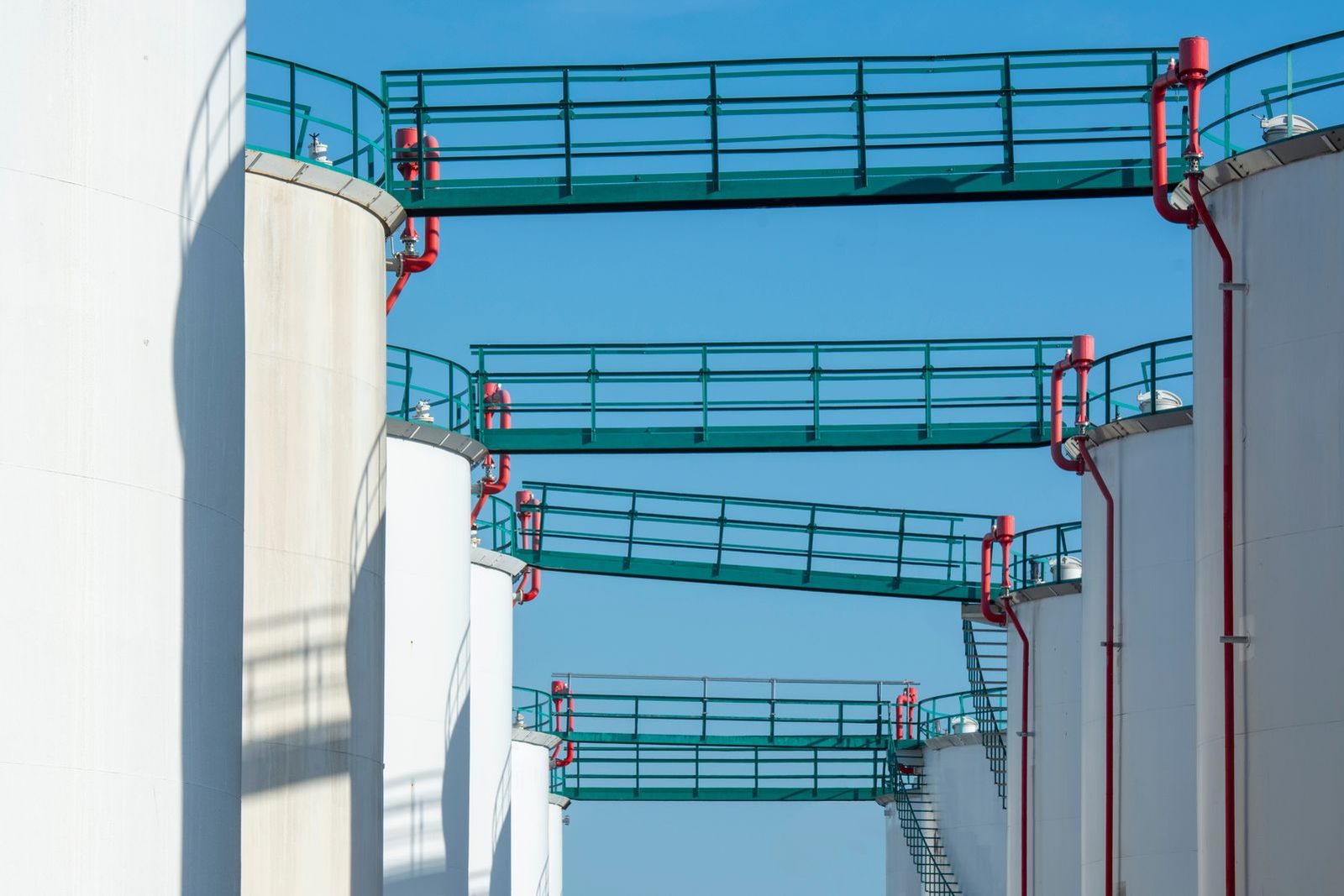
White cylindrical tanks and blue piping laid out in dense rows across the plant site
Once the mixer box of the extraction circuit foams, the phase-disengagement interface in the settler refuses to clear; organic phase is carried off with the aqueous phase, the metal content of the raffinate and the extractant loss both climb, and the output of an entire shift is pinned down by the settling time.
Chemi Tech supplies the KM-03 series of defoamers for copper, nickel-cobalt and phosphoric acid extraction systems; the dosage is adjusted flexibly by feed acidity, phase ratio and mixing time. This grade resists strong acid and alkali and withstands high temperature; held in the same system as common extractants and diluents it does not shift the two-phase distribution, nor does it aggravate the emulsification tendency of the organic phase. The measured settling time in the clarifier and the metal content of the raffinate are checked against each other, and the precise dosage of the KM-03 series is then settled.
Advantages of Chemi Tech Defoamers
The Chemi Tech KM-03 series defoamer is configured for hydrometallurgical extraction systems. It resists strong acid and alkali, and does not decompose or lose effect in high-acidity feeds or in the high-acid environment of the stripping stage; it withstands high temperature, and the foam-suppressing duration stays long when the extraction circuit runs at elevated temperature; held in the same system as common extractants and diluents it does not shift the two-phase distribution, and the extraction isotherm is not displaced by the addition; it does not aggravate the emulsification tendency of the organic phase, and the phase-disengagement interface in the clarifier resolves clean; the foam-breaking speed is fast, and the foam layer falls back markedly once agitation stops in the mixer box; and the dosage is economical, set against feed acidity, so the defoaming spend per tonne of feed can be apportioned to each shift for accounting.
Industry Pain Points and Solutions
The root of foaming in an extraction system lies mostly in the combined effect of elevated feed acidity and degradation products in the organic phase, while the rise in agitation intensity in the mixer box further stabilises fine bubbles between the two phases, finally concentrating in two places: the settling time and the organic entrainment.
Once the feed acidity is raised, foam in the mixer box is dragged into the organic phase, and a stable intermediate layer is pulled across the phase-disengagement interface. KM-03 resists strong acid and alkali; with acidity and phase ratio sorted out, the dosage of this series is re-set against the interface condition, and the intermediate layer thins accordingly.
Organic entrainment is already sensitive at a high phase ratio, and with more foam the metal content of the raffinate climbs while the extractant loss is amplified in step. KM-061 withstands high temperature; once the mixing time and the residence time in the clarifier are established, the dose is graded accordingly, and the metal content of the raffinate falls back inside the specification line.
Rising feed temperature in summer pushes the difficulty of foam suppression up another notch. The KM-03 series withstands high temperature and adds no extra replenishment frequency at that level; with acidity, phase ratio and mixing time all sorted out, the precise dosage of this stage is graded, and the workshop executes at that grade.
Typical Operating Conditions and Verification
Customer case: the extraction workshop of a copper smelter in Jiangxi, applied to foam control in the copper extraction and stripping stages.
The copper content of the raffinate rebounded repeatedly near the specification line; the settling time in the clarifier stretched from the design value to nearly double; and the per-shift make-up volume of extractant climbed shift by shift. After comparison against feed acidity and phase ratio, KM-061 was dosed, with the amount set by mixing time and clarifier residence time. Once in service, the phase-disengagement interface cleared again; the copper content of the raffinate fell below the specification line; the per-shift make-up of extractant no longer climbed shift by shift, and the agitation intensity in the mixer box returned to its original setting.
Frequently Asked Questions
Will using a defoamer in an extraction system pull the two-phase distribution off course?
What directly determines whether the two phases shift is the solubility and interfacial activity of the defoamer in the organic phase. The KM-03 series does not change the distribution ratio when held in the same system as common extractants and diluents; the measured interfacial-tension and settling-time data are issued by Chemi Tech after side-by-side comparison on the same extraction stage, and dosing at the settled level does not displace the extraction isotherm. The actual dosage is referenced against the feed acidity and phase ratio of the current shift; Chemi Tech combines the two sets of data and settles the fitted dosage.