
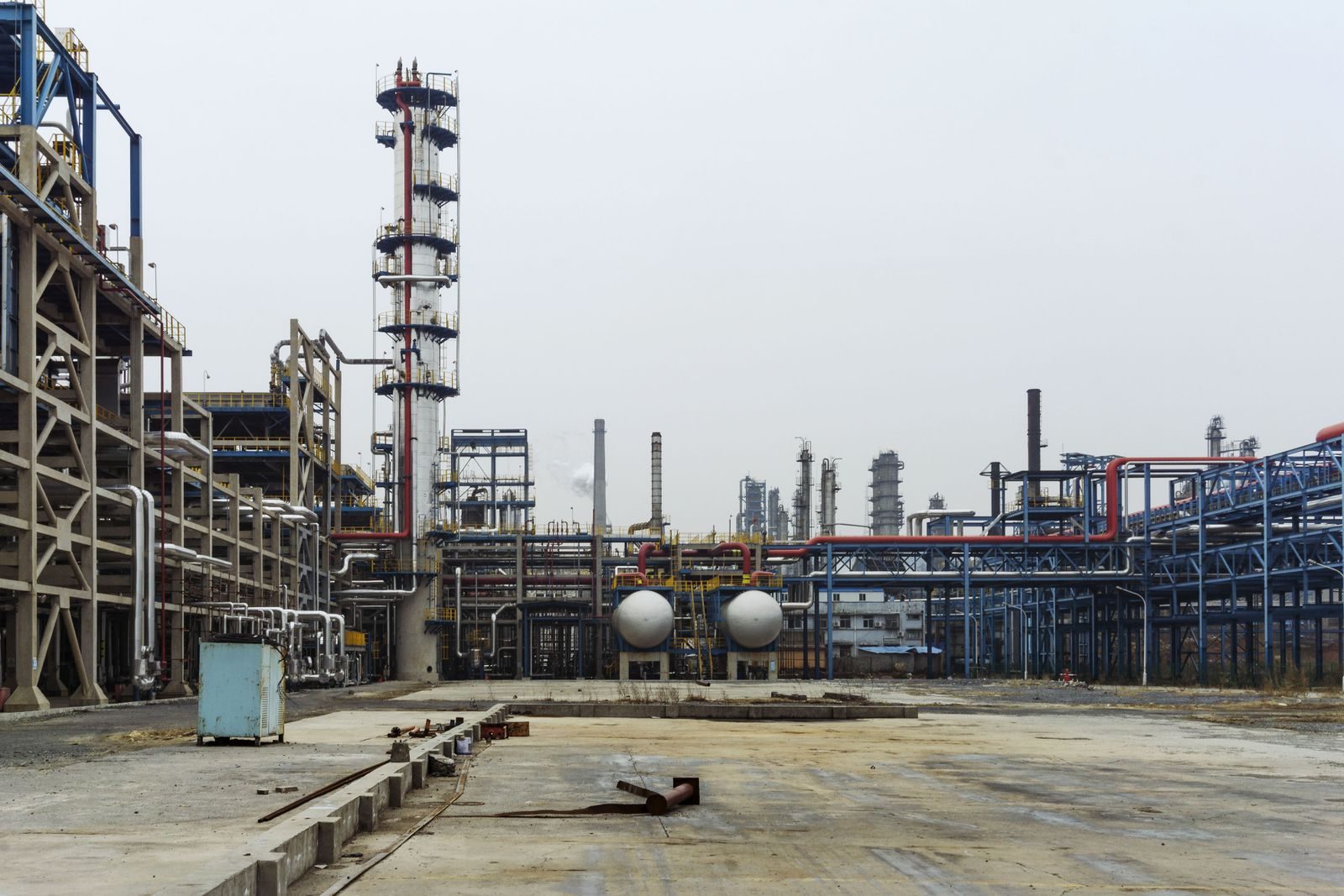
Towers and spherical tanks arranged in rows along the pipe rack of a petrochemical plant
The level reading in the crude tower overhead reflux drum runs falsely high, the differential pressure across the amine regenerator climbs with it, liquid carry-over in the overhead gas and the regeneration degree of the lean amine fall together, and operators can only buy temporary stability inside the tower by cutting load.
Chemi Tech introduces the KM-6100 series of defoamers for the crude and vacuum distillation and amine regeneration systems of refineries; the dosage is adjusted flexibly by feed oil acid number, tower overhead temperature and regenerator differential pressure. This grade is a silicone-free formulation; it withstands high temperature and resists acid and alkali, and long-term dosing forms no silica scale on trays or packing surfaces, nor does it aggravate the inherent foaming tendency of the amine itself. Measured data on the fluctuation of the overhead reflux drum level and the trend of the regenerator differential pressure are read against each other, and the fitted dosage of the KM-6100 series is settled accordingly.
Advantages of Chemi Tech Defoamers
The Chemi Tech KM-6100 series defoamer is configured for the crude and vacuum distillation and amine regeneration systems of refineries. It is a silicone-free formulation, and long-term dosing forms no silica scale on trays or on the regenerator packing, so the descaling workload in the turnaround is not increased; it withstands high temperature and does not decompose or lose effect in the oil and gas environment above 130°C at the tower overhead; it resists acid and alkali, and its foam-suppressing capacity does not decay as degradation products accumulate in the circulating amine; held in the same system as lean and rich amine it does not aggravate the inherent foaming tendency of the system, and the regeneration degree of the lean amine is not lowered by the addition; the foam-breaking speed is fast, and the false level reading in the overhead reflux drum falls back markedly; and the dosage is economical, set against the feed oil acid number, so the defoaming spend per tonne of amine can be accounted directly.
Industry Pain Points and Solutions
The root of foaming in an amine system lies mostly in the combined effect of surface-active species brought in by a high feed oil acid number and the vapour-liquid shear inside the tower, while the accumulation of degradation products in the circulating amine further stabilises the foam above the trays, finally concentrating in two places: the false level at the tower overhead and the regenerator differential pressure.
When the feed oil acid number runs high, the foam layer in the overhead vapour-liquid separation space thickens first, and the false level in the reflux drum follows. KM-6100 withstands high temperature and resists acid and alkali; with the acid number and the overhead temperature readings set out, its dosage is re-set against the tower load, and the false level reading comes into agreement with the field gauge glass.
Degradation products accumulate in the regenerator, the foam on the trays pushes the differential pressure up, and the regeneration degree of the lean amine falls in step. KM-6120 is silicone-free and withstands high temperature; once the differential pressure trend and the circulating amine concentration are checked through, the dosage is set to the fitted grade of that tower, and the differential pressure no longer climbs shift by shift.
The COD and silicon content of the discharged wastewater must be checked as well. The KM-6100 series is a silicone-free formulation and adds no extra laboratory workload on that item; once the variables are checked through, the fitted dosage of that tower is clarified, and the workshop doses at that level.
Typical Operating Conditions and Verification
Customer case: the crude and vacuum distillation and amine regeneration units of a local refining enterprise in Shandong, applied to the foam-control stage of overhead vapour-liquid separation and the regenerator.
After checking through the feed oil acid number and the tower overhead temperature, Chemi Tech settled on KM-6120 as the defoamer grade for that tower, with the dosage set by the regenerator differential pressure and the circulating amine concentration. Before that, the level reading in the overhead reflux drum had never matched the field gauge glass, and the regenerator differential pressure had to be set one notch higher every shift. After switching to that grade, the change appeared first in the reflux drum: the level reading came into agreement with the gauge glass; then the regenerator differential pressure no longer climbed shift by shift; the regeneration degree of the lean amine returned to near the design value, and one less layer of deposit was found on the tray surfaces at turnaround.
Frequently Asked Questions
Will long-term dosing of the KM-6100 series in amine affect the regeneration degree of the lean amine?
It depends on whether the amount of silicon introduced falls within the assessment range of that tower. The KM-6100 series is a silicone-free formulation, and long-term dosing forms no silica scale on trays or on the regenerator packing; the measured data on lean-amine regeneration degree and foam layer height are issued by Chemi Tech from controlled measurement on the same operating stage, and within the settled dosage grade it does not interfere with the inherent absorption and regeneration capacity of the amine. The actual dosage is corrected against field amine concentration and differential pressure readings; Chemi Tech issues the fitted dosage for that tower by operating-condition comparison.