
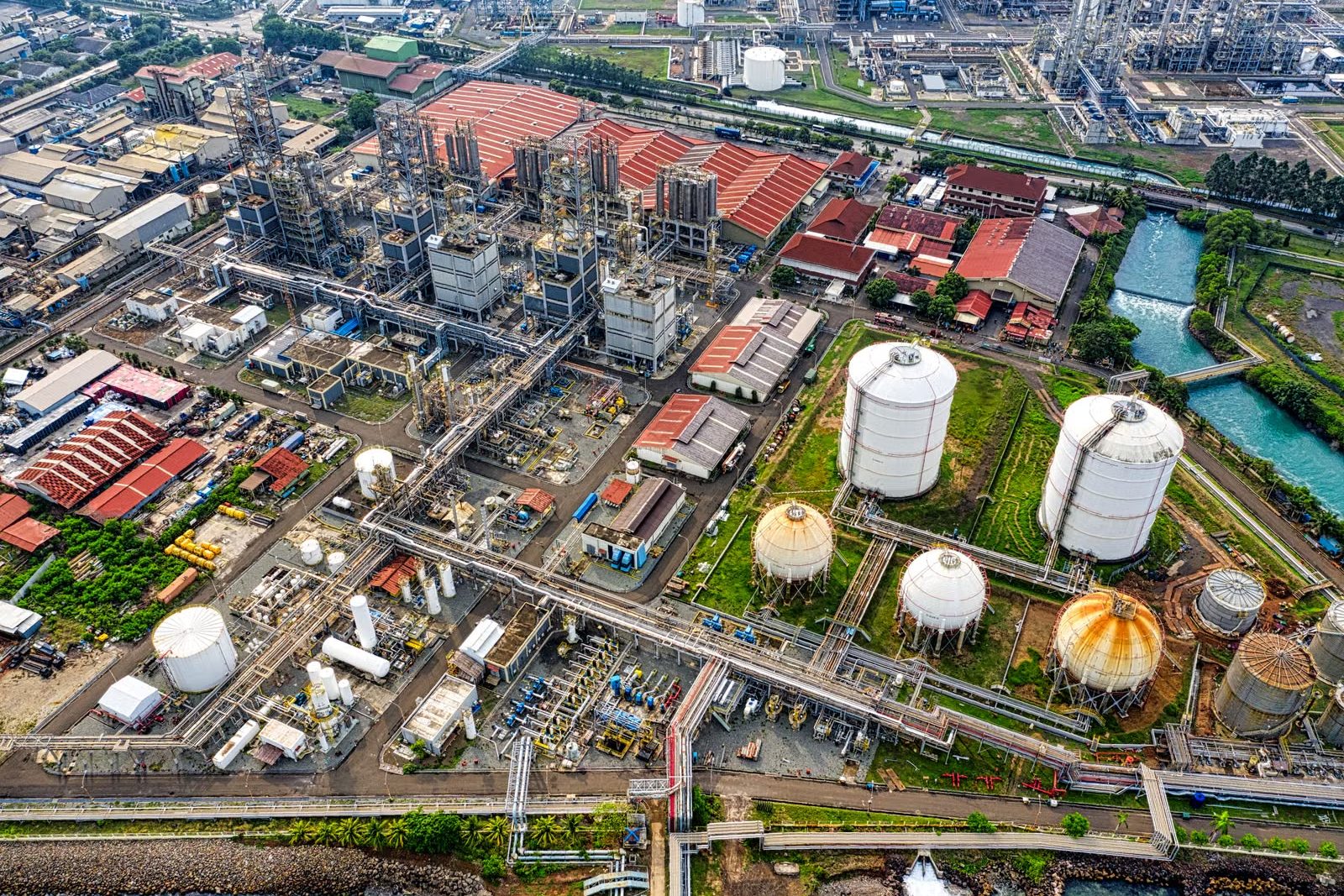
A tank farm seen from above, with circular tanks arranged in clusters and pipe racks running among them
The oil-water interface reading of a three-phase separator keeps drifting and the water cut of the crude oil rises with it, so the central processing station can only buy temporary compliance of the exported oil by extending settling time.
Chemi Tech introduces the KM-1210 series of defoamers for oilfield production and oil-gas separation systems; the dosage is rated in grades by produced-fluid salinity and incoming gas content. This grade is temperature- and salt-resistant: its foam-breaking speed does not decay in high-salinity produced fluid, using it in the same tank as common demulsifiers does not change the oil-water partition, and it does not aggravate the emulsification tendency of the produced fluid. The measured data of interface reading and settling-tank water draw-off frequency are entered on the same inspection sheet, and the precise dosage of the KM-1210 series is given directly by these two sets of readings.
Advantages of Chemi Tech Defoamers
The Chemi Tech KM-1210 series defoamer is configured for oil-gas separation and crude-oil settling at an oilfield central processing station. It is temperature- and salt-resistant, and its foam-breaking speed does not decay in high-salinity produced fluid; it breaks foam fast, so the foam layer falls back noticeably once liquid feed stops; its foam-suppressing duration is long-lasting, so make-up dosing within a shift is clearly reduced; used in the same tank as common demulsifiers it does not change the oil-water partition; its dosage is adjusted step by step with produced-fluid salinity; and it does not aggravate the emulsification tendency of the produced fluid, so the shift make-up of demulsifier need not be raised separately.
Industry Pain Points and Solutions
The root of foaming in oil-gas separation lies mostly in the combined effect of high produced-fluid salinity and the gas content of the wellhead incoming fluid, while multi-stage pumping stabilises fine bubbles at the oil-water interface, finally producing two problems: interface-reading drift and a rising crude-oil water cut.
When produced-fluid salinity is high, salts stabilise the film of fine bubbles and the interface reading is slow to settle. KM-1210 is temperature- and salt-resistant; once the two readings of salinity and incoming gas content are set out, its dosage is re-rated by the separator load, and the oil-water interface is drawn clean.
After the incoming gas content is turned up, the foam layer builds up in the upper part of the separator and crude-oil water cut and settling time rise together. KM-1210 does not lose foam-breaking speed in high-salinity produced fluid; once two paired sets of readings, interface reading against crude-oil water cut and settling-tank water draw-off frequency against export handover-inspection rounds, are compared, the dosage is rated to the fitted grade of that station and the crude-oil water cut falls back within the handover-inspection range.
When the number of gathering-pump stages is increased, shear refines the fine-bubble size further and the change in interfacial tension raises demulsifier consumption in step. The KM-1210 series is temperature- and salt-resistant and adds no extra demulsifier make-up on this item; once salinity, incoming gas content and pumping stages are checked together, the precise dosage corresponding to the interface state has a basis, and the central processing station arranges the shift water draw-off accordingly.
Typical Operating Conditions and Verification
Customer case: the oil-gas central processing station of an oilfield service enterprise in Xinjiang, applied to the oil-gas treatment stages of a three-phase separator and a crude-oil settling tank.
At this plant the interface reading had repeatedly rebounded within a single shift, and the settling-tank water draw-off frequency had risen with it. From comparison of produced-fluid salinity and settling time, KM-1210 was selected for that central processing station, with the dosage graded by separator operating pressure; interface reading and crude-oil water cut were recorded shift by shift, and settling-tank water draw-off frequency against export handover-inspection rounds formed a separate paired comparison. After commissioning, the oil-water interface was drawn clean; the crude-oil water cut no longer rebounded shift by shift; and the settling-tank water draw-off cycle was stretched from once per shift to once every two shifts.
Frequently Asked Questions
In high-salinity produced fluid, will the foam-suppressing duration of a defoamer be shortened markedly?
It depends on whether salinity and gas content fall within the established handover-inspection range of that station. The KM-1210 series is temperature- and salt-resistant and does not lose foam-breaking speed in high-salinity produced fluid; the measured data of interface reading and crude-oil water cut are given by Chemi Tech after comparative measurement on the same separation section, and dosing at the rated magnitude does not change the oil-water partition. The shift addition is fine-tuned with incoming gas content and settling time, and Chemi Tech fixes the precise dosage of that station from the side-by-side measurements of interface and water cut.