
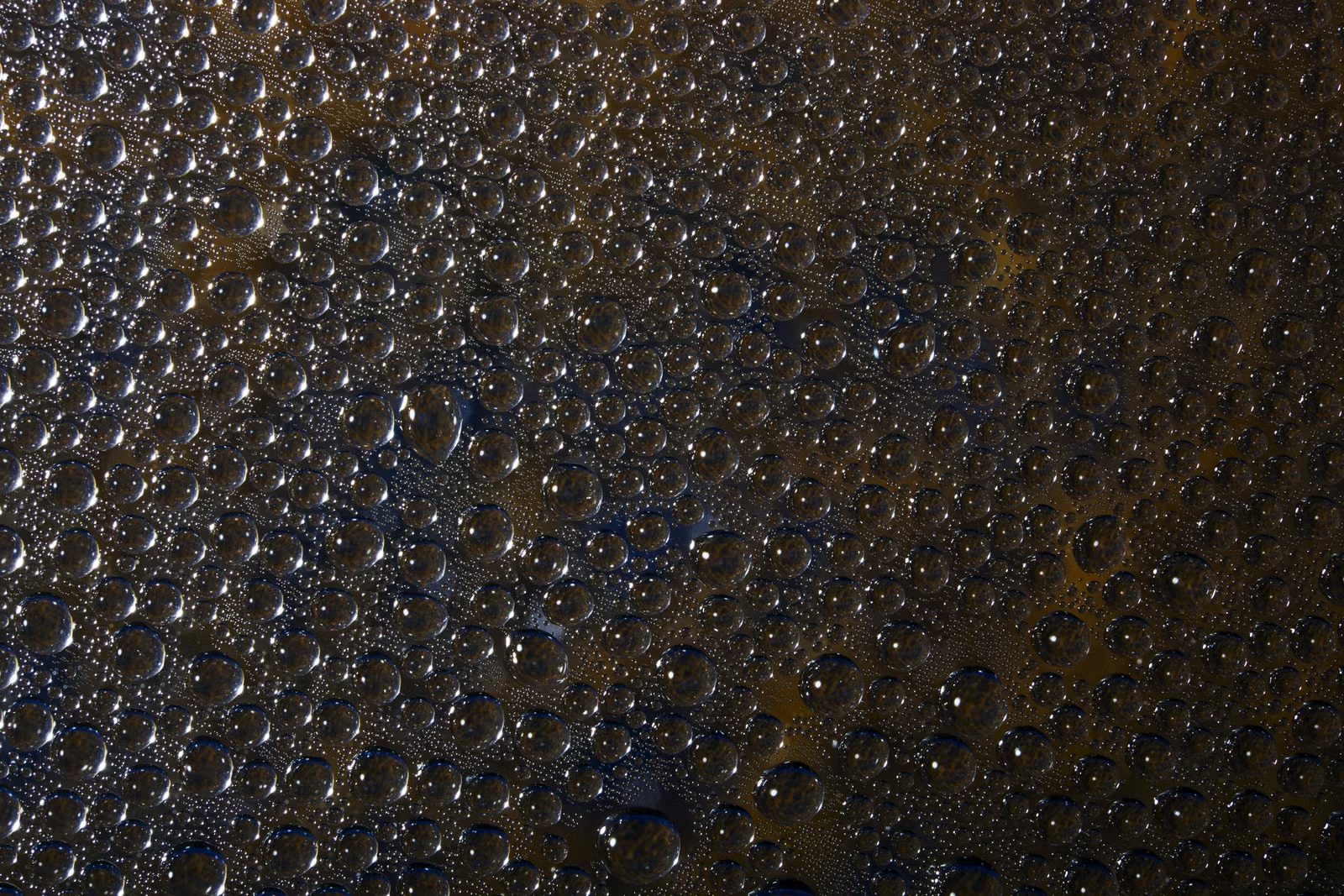
Water droplets beading into fine dense particles on the surface of a dark fabric
After many rounds of industrial laundering, the oil-repellency grade of workwear and table linen falls grade by grade, waterborne oily stains penetrate inward along the warp and weft, and re-washing and touch-up finishing put the delivery schedule under pressure at the finishing stage.
Chemi Tech has introduced the KMF-1601 series of water repellents for the water- and oil-repellent finishing of workwear and linen; the dosage is adjusted flexibly by substrate grammage, wet pickup and curing temperature. This grade forms a continuous film on the fibre surface, does not seal the original breathable channels of the fabric, causes no emulsion breaking when used in the same bath as the softener in the finishing liquor, and the film withstands many rounds of industrial laundering after curing. The measured data on AATCC 22 spray rating and oil-repellency grade are compared side by side, and the fitted dosage of the KMF-1601 series is graded from them.
Advantages of Chemi Tech Water Repellents
The Chemi Tech KMF-1601 series water repellent is configured for the finishing stations of workwear and linen. Its film formation is continuous, so the capillary channels at seams and folded edges are fully covered; the oil-repellency grade is stable, so the fall in grade after many rounds of industrial laundering stays controllable; its water repellency is good, so waterborne oily stains left on the fabric surface are easy to wipe off; its compatibility is excellent, with no emulsion breaking in the same bath as the softener; the dosage is economical, graded by substrate grammage; and fabric hand and breathability stay stable after curing.
Industry Pain Points and Solutions
The root of oil-repellency decay in linen lies mostly in the combined effect of low wet pickup and insufficient curing temperature, while the high temperature and mechanical force of industrial laundering further peel the film away step by step, finally producing two problems: a drop in oil-repellency grade and oil-stain penetration.
When wet pickup runs low, the finishing liquor spreads unevenly on the fibre surface and local grade drops appear first in the spray rating of the fabric. KMF-1601 forms a continuous film; once the two readings of substrate grammage and wet pickup are set, its dosage is re-rated by pad pressure, and the spray rating returns to the acceptance grade.
After curing temperature is insufficient, the film is under-crosslinked and the oil-repellency grade and hydrostatic pressure resistance fall together. KMF-1601 forms a continuous film on the fibre surface; the two sets of readings, AATCC 22 spray rating against oil-repellency grade, and hydrostatic pressure resistance against oil-stain penetration width, are compared side by side, the addition is rated to the fitted grade of that batch, and the oil-repellency grade no longer falls cycle after cycle.
When substrate grammage reaches the upper limit, the path for the finishing liquor to penetrate into the fabric core lengthens and the uniformity of the film after curing falls in step. The KMF-1601 series causes no emulsion breaking in the same bath as the softener and adds no extra touch-up finishing rounds on this item; once the three readings of substrate grammage, wet pickup and curing temperature are brought together, the optimal dosage of that batch is settled and the finishing hall sets its process card at that grade.
Typical Operating Conditions and Verification
Customer case: the finishing workshop of a hotel linen laundering enterprise in Inner Mongolia, applied to the water- and oil-repellent finishing stage of workwear and table linen.
Before the switch in this plant, the oil-repellency grade of whole batches of linen needed touch-up finishing once every wash cycle and oil-stain penetration was repeatedly found at finished-goods inspection. After comparison of substrate grammage and wet pickup, KMF-1601 was chosen, with the addition rated by curing temperature and pad pressure; AATCC 22 spray rating and oil-repellency grade were logged by batch, and hydrostatic pressure resistance against oil-stain penetration width formed a second side-by-side set. After the solution was in place, the spray rating returned to the acceptance grade; oil-stain penetration was no longer found batch after batch, and touch-up finishing rounds were cut from once a cycle to once every three cycles.
Frequently Asked Questions
Will finishing the KMF-1601 series in the same bath as the softener weaken the oil-repellency grade of the linen?
First check whether wet pickup and curing temperature fall within the crosslinking window of that batch. The KMF-1601 series forms a continuous film on the fibre surface and causes no emulsion breaking in the same bath as the softener; the measured data on AATCC 22 spray rating and oil-repellency grade are given by Chemi Tech from controlled side-by-side measurement of the same finishing batch, and dosing at the rated magnitude does not change the original breathability rhythm of the fabric. The field dosage is fine-tuned again by substrate grammage, and Chemi Tech settles the fitted dosage of that batch from side-by-side measurement of the same batch.