
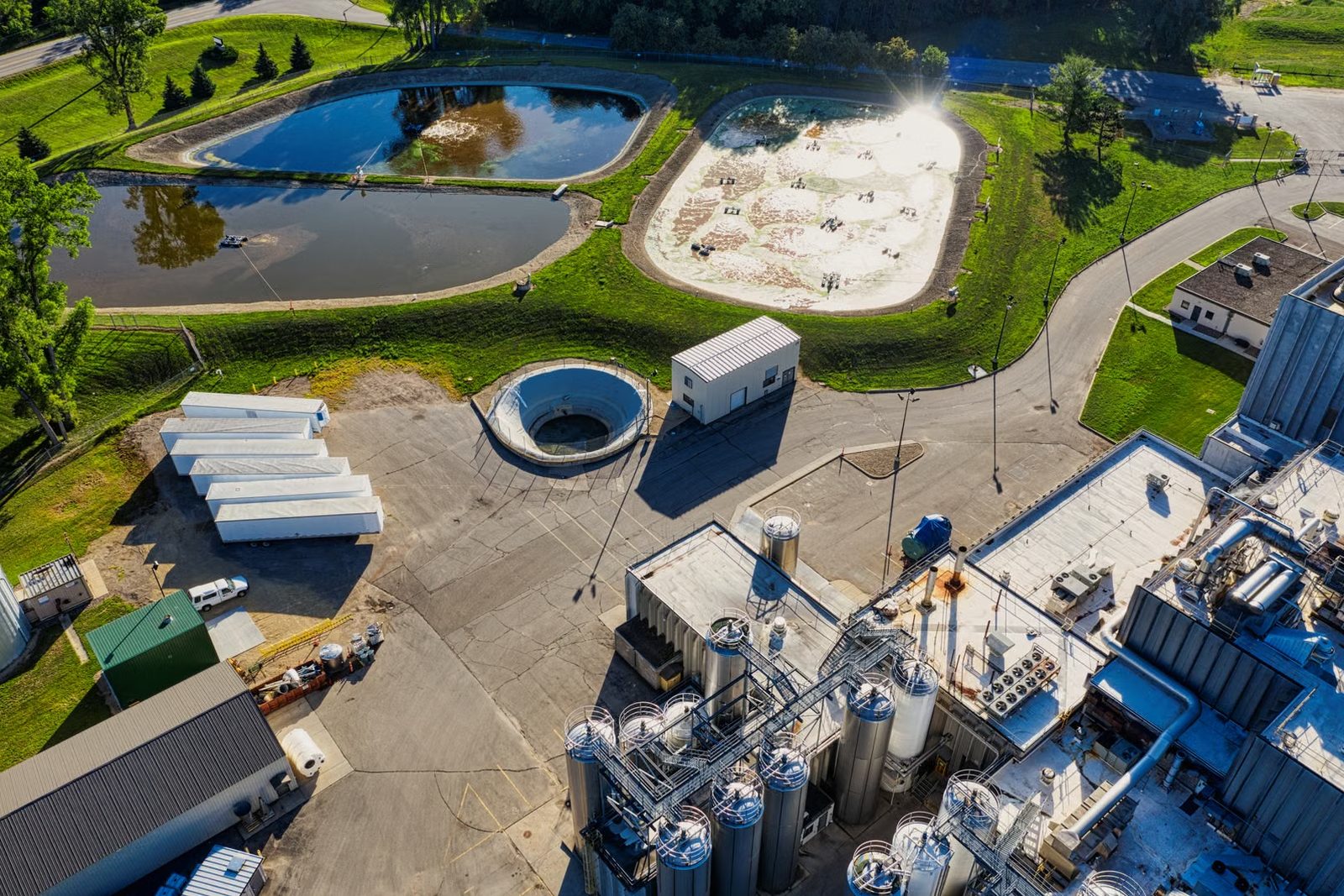
An overhead view of a wastewater treatment pool showing white foam accumulating on the water surface
Once the absorber slurry starts foaming, the foam layer keeps thickening inside the tower, oxidation air utilization falls in step, the solids content of the gypsum cyclone feed drops at the same time, and the dewatering system is forced to run at reduced load.
For the slurry system of a flue gas desulfurization absorber tower, Chemi Tech supplies the KM-237 series of defoamers; the dosage is adjusted flexibly by slurry density, oxidation air rate, chloride ion concentration and tower temperature. This grade is a polyether-based system that resists high temperature, keeps a long-lasting foam-suppressing effect in the acidic, salt-bearing environment inside the tower, does not react with gypsum seed crystals and does not affect the oxidative conversion of calcium sulfite. The measured data of the foam-layer height inside the tower and the moisture content of dewatered gypsum are checked side by side, and the fitted dosage of the KM-237 series is set accordingly.
Advantages of Chemi Tech Defoamers
The Chemi Tech KM-237 series defoamer is configured for the slurry of a flue gas desulfurization absorber tower. It is a polyether-based system that resists high temperature and does not decompose or fail in the high-temperature slurry environment of the tower; its foam-suppressing effect is long-lasting and the foam-layer height stays controllable when the oxidation air fluctuates; its compatibility is excellent and it does not react with gypsum seed crystals or calcium sulfite; it breaks foam fast and the foam layer inside the tower falls back noticeably; it resists acid and alkali and stays stable when the slurry pH drifts; and the dosage is economical, rated by slurry density and chloride ion concentration, so the defoaming cost per tonne of slurry can be accounted directly.
Industry Pain Points and Solutions
The root of foaming in the absorber tower lies mostly in the combined effect of a too-high slurry density and oxidation-air shear, while the accumulation of chloride ions and calcium sulfite stabilises the fine bubbles in the slurry, finally concentrating in two places: the foam-layer height and the moisture content of dewatered gypsum.
When the slurry density rises, the foam layer inside the tower first builds up and the solids reading of the returning slurry reads falsely high. KM-237 resists high temperature, acid and alkali; once the two readings of density and tower temperature are set, its dosage is re-rated by the load inside the tower, and the foam-layer reading comes into line with the on-site sampling.
When the oxidation air rate is too high, the foam is entrained deep into the slurry by vapour-liquid shear and the feed concentration of the dewatering cyclone falls in step. The KM-237 polyether system suppresses foam lastingly; with the two sets of readings compared side by side, the air rate falls from 18 standard cubic metres per tonne to 14, the foam-layer height narrows from 45 cm to 20 cm, and the moisture content of dewatered gypsum falls back in step.
When chloride ions accumulate, the fine bubbles are stabilised in the slurry by the salt and the dispersing difficulty of the chemical rises. The KM-237 series adds no extra top-up frequency in salt-bearing slurry; with the four readings of density, oxidation rate, chloride ions and tower temperature checked together, the fitted dosage of that tower is made clear and the desulfurization shift crew doses by grade.
Typical Operating Conditions and Verification
Customer case: the desulfurization workshop of a coal-fired power plant in Shanxi, applied to the defoaming stage of the absorber slurry.
At that plant the foam layer of the absorber slurry stayed pressed against the upper part of the tower for a long time, the solids content of the gypsum cyclone feed rebounded around the acceptance line again and again, and the filter-cake moisture in the dewatering house stayed high continuously. KM-237 was dosed after comparison against slurry density and chloride ions, with the amount rated by oxidation air rate and foam-layer height. After it was put into service, the foam-layer reading narrowed from 45 cm to 20 cm; the solids content of the gypsum cyclone feed returned to the design range; the filter-cake moisture fell in step, and the shift load of the dewatering system came back within schedule.
Frequently Asked Questions
Does dosing the KM-237 series over the long term in desulfurization tower slurry affect the dewatering performance of the gypsum?
It all depends on whether the compatibility of the defoamer in the slurry falls within the control range of that tower. The KM-237 series is a polyether-based system that does not react with gypsum seed crystals or calcium sulfite; the measured data of the foam-layer height and the filter-cake moisture are given by Chemi Tech after side-by-side comparison of the same tower section, and within the rated dosage grade they do not interfere with the oxidation and dewatering process. The actual dosage is corrected by the on-site slurry density and foam-layer reading; Chemi Tech gives the fitted dosage of that tower from the comparison of operating conditions.